Article: Small Duct, Big Deal, The Complete Guide to High Velocity HVAC
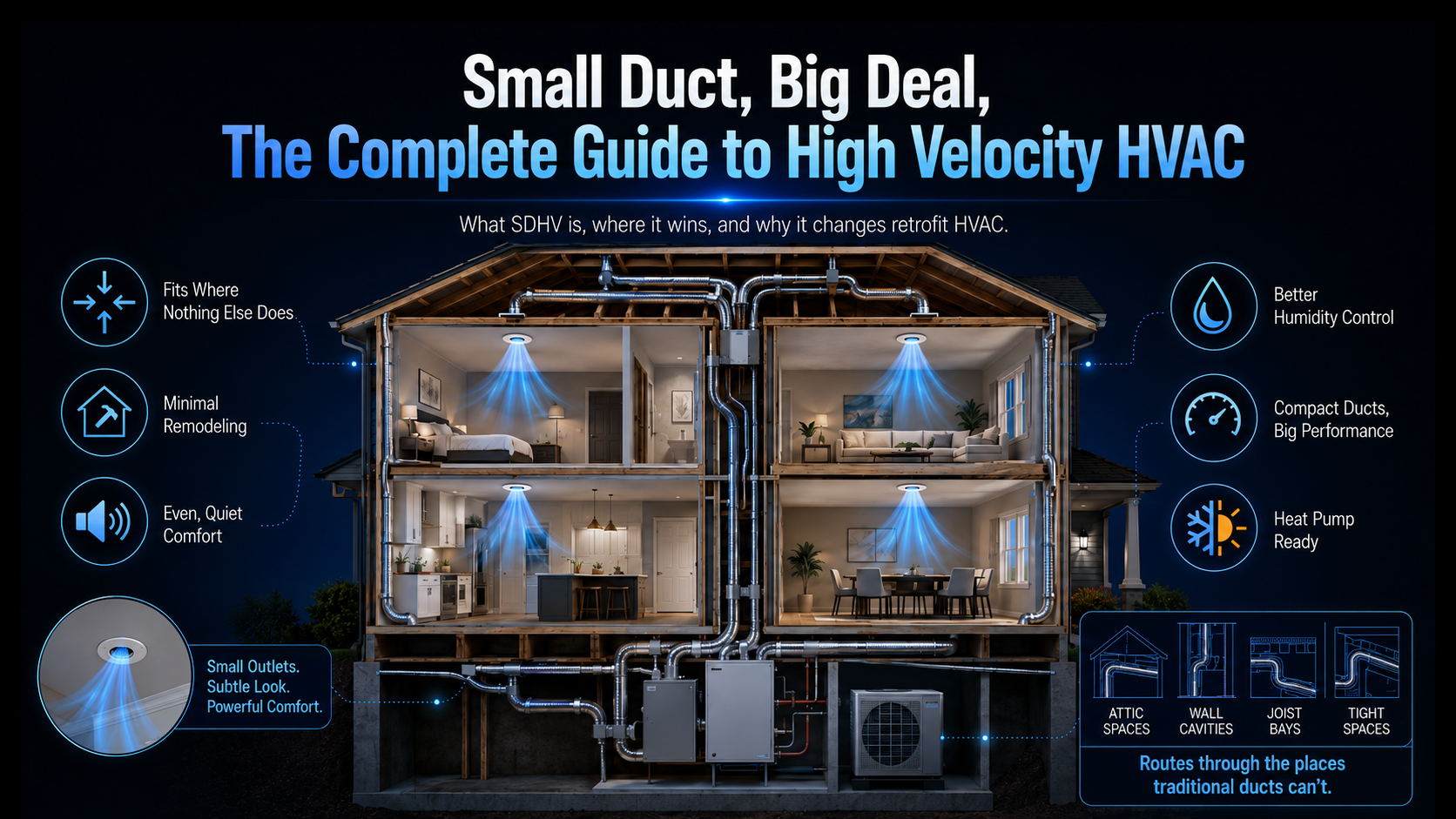
Small Duct, Big Deal, The Complete Guide to High Velocity HVAC
Why the smartest heating and cooling system in the industry is the one you'll never see — and why, after nearly a decade of shipping this equipment across North America, we're more convinced than ever.
Back in 2016 we shared one of our first blog posts on The Unico System. It was short, it was earnest, and it covered the basics: small ducts, quiet air, no remodeling. Almost ten years later, that post still gets traffic every single week — which tells you two things. One, people are still hunting for straight answers about small duct high velocity (SDHV) systems. Two, we owed everyone a much better write-up.
So here it is. This is the long(er) version. The everything version. What SDHV actually is, why it works, where it wins, where it doesn't, who makes it, how the brands stack up, and what it costs. No fluff, no scare tactics, no “call now for a free estimate” nonsense. We sell this equipment every day — parts, outlets, coils, air handlers, complete systems — and we've spent close to a decade answering questions from homeowners, contractors, and engineers on both sides of the border. This post is everything we've learned, in one place.
Part 1: What Is Small Duct High Velocity, Really?
Strip away the marketing and SDHV is a beautifully simple idea: instead of pushing large volumes of air slowly through big, boxy sheet-metal ducts, you push smaller volumes of air fast through flexible tubes roughly two inches in diameter.
That's it. That's the whole trick. But the consequences of that one design decision ripple through everything — installation, comfort, efficiency, aesthetics, even how the air feels on your skin.
A conventional forced-air system needs ducts the size of a moving box. Six-inch, eight-inch, sometimes fourteen-inch rectangular trunks that demand dropped ceilings, bulkheads, furred-out walls, and sacrificed closets. If your house was built with them, fine. If it wasn't — and millions of homes across Canada and the US weren't — retrofitting them means demolition. Real demolition. Plaster comes down, floors come up, and your century home's original crown moulding goes in a dumpster.
An SDHV system takes a different route. Literally. The supply tubing is small enough to snake through existing stud bays, joist spaces, and closet corners — the same cavities your plumbing and wiring already live in. The air handler itself is compact and modular; it tucks into an attic, a crawlspace, a closet, or hangs from the basement ceiling. One trunk line, a network of flexible two-inch runs, and small round outlets about the size of a hockey puck where the air enters the room.
The industry calls the delivery principle aspiration. Conventional systems dump air into a room and hope it mixes. High velocity systems inject a focused stream of air that creates gentle suction around itself, actively pulling the room's air into circulation. The result is continuous, even mixing — no stratification, no cold pockets by the window, no hot upstairs bedroom in July. Floor to ceiling, room to room, the temperature spread in a properly designed SDHV home is typically within about two degrees of the thermostat setting.
If you've ever lived in a house where the thermostat says 22 and the bedroom says “bring a sweater,” you already understand why that matters.
Part 2: The Benefits, Unpacked One by One
Everybody's got a bullet list. Let's actually explain why each benefit exists, because the “why” is what separates a sales page from an honest answer.
1. It fits where nothing else does
This is the headline act, and it's earned. The supply tubing on a Unico system, for example, routes through cavities as small as a standard stud bay. The modular air handler breaks into components — blower module, coil module — that can be carried up an attic ladder one piece at a time and assembled in place. Unico's own numbers put it at less than one-third of the built-environment space of a traditional system, capable of delivering up to nine tons of conditioning in the footprint a conventional three-ton system would need.
For pre-war homes, heritage properties, homes on radiators or boilers with zero existing ductwork, post-and-beam construction, churches, condos with concrete ceilings — this is frequently the only central air option that doesn't involve tearing the building apart. That's not hype; it's geometry.
2. Little or no remodeling
Follows directly from point one, but deserves its own line because this is where the money is. Retrofitting conventional ductwork into a finished older home can run $10,000–$25,000 in carpentry, drywall, and restoration before the HVAC contractor even shows up. SDHV eliminates most of that. Small holes, surgical routing, minimal patching. Your plaster medallions survive. Your original trim survives. Your marriage survives the renovation.
3. Draft-free, even temperatures
Aspiration again. A conventional register blows a slow, wide sheet of air that falls into the room (cold air) or hugs the ceiling (warm air), creating drafts near the outlet and stagnation everywhere else. A high velocity outlet delivers a narrow, fast stream that entrains the surrounding air and keeps the entire room volume gently in motion. There's a real, measurable comfort effect here: the continuous mixing lowers the effective room temperature by a couple of degrees in cooling season, which means the room feels cooler than the thermostat number says it should.
4. Superior humidity removal — the sleeper benefit
This might be the most underrated advantage in the entire category, especially anywhere with real summers — southern Ontario included.
Because SDHV systems move air across a deep coil at a carefully engineered rate, the air spends more quality time in contact with the cold coil surface. More contact time means more moisture condensed out. Unico's coil design in particular removes up to 30% more humidity than conventional equipment, and that's not a footnote — it changes how you run your whole house.
Dry air at 25°C feels better than muggy air at 22°C. So you set the thermostat higher, the system runs less, and the house feels better while your hydro bill goes down. Humidity control is comfort. Comfort you don't have to pay to overcool your way into.
5. Quiet — genuinely quiet, when installed right
The tubing on a quality SDHV system is engineered as a sound attenuator: a nylon inner core wrapped in insulation that absorbs the noise of moving air along the run. The air handler modules are lined with closed-cell, sound-deadening insulation. Done properly — correct run lengths, no tight bends near the outlet, enough outlets per ton — the system fades into a soft background whisper.
I'll be straight with you, because someone should be: a badly installed high velocity system can whistle. Every noisy SDHV horror story you'll find on a forum traces back to the same installation sins — runs cut too short, tight-radius bends jammed right behind the outlet, or a designer who cheaped out on outlet count and pushed too much air through too few openings. The physics don't forgive shortcuts. Follow the manufacturer's design manual (Unico's documentation, for the record, is the gold standard in this industry) and you get a system quieter than most conventional forced-air setups. Cut corners and you've built a flute. Choose your installer accordingly — or if you're a capable DIYer or contractor speccing your own job, read the manuals cover to cover. They're good.
6. Duct efficiency — the part nobody talks about
Everyone obsesses over SEER ratings and ignores the ductwork, which is a bit like tuning a race engine and bolting on rusted-out exhaust. Two things kill conventional duct performance:
Thermal loss. Heat leaks through duct walls in proportion to surface area. SDHV tubing has roughly one-third the surface area of equivalent conventional ducting, and every run is wrapped in insulation with an outer vapor barrier. Less surface, better wrap, less loss. Simple.
Duct leakage. Third-party testing has documented conventional systems losing up to 25% of their conditioned air through leaky seams and joints — air you paid to heat or cool, dumped into your attic. A properly assembled SDHV system loses under 5%. The fittings are engineered connections, not tape-and-prayer sheet metal seams.
Stack those two together and the delivered efficiency gap between SDHV and a typical conventional install is bigger than the gap between a mid-tier and premium condenser. Ductwork is efficiency. It just doesn't get a yellow EnergyGuide sticker, so nobody thinks about it.
7. Your home still looks like your home
The outlets are the only visible evidence the system exists: small round openings about five inches in outer diameter, or slotted versions at roughly half an inch by eight inches that all but disappear into trim work. They install in ceilings, floors, or sidewalls; they come in a range of finishes; they can be painted or stained to match anything. We stock a full wall of them — 2″ round, 2.5″ round, and slotted trim plates — and honestly, half the fun of this category is how strongly people feel about outlet aesthetics once they realize they have options beyond “stamped metal register that streaks.”
8. Heating, cooling, and heat pump ready
A common misconception is that SDHV is a cooling-only technology. Not so. Modern air handlers accept hot water (hydronic) coils fed by your boiler, electric heat modules, or refrigerant coils matched to heat pumps. If you've got a boiler-and-radiator home, an SDHV system with a hydronic coil is one of the most elegant setups in residential HVAC: radiant heat in winter, high velocity cooling in summer, one set of invisible ductwork doing double duty. Contractors who've done these combos will tell you it's a match made in heaven — because it is.
And with the electrification wave rolling across North America, the heat pump pairing story has become the most important chapter in SDHV's modern history. More on that below, because it deserves its own section.
Part 3: The Players — Who Makes This Stuff?
The SDHV world is a small neighbourhood with a few serious residents. Here's the honest tour.
The Unico System — the benchmark
Unico (St. Louis, Missouri) is the name that built the modern residential SDHV category, and it remains the backbone of everything we do at High Velocity Outlets. Trusted in over half a million homes. If you've seen a high velocity system in a magazine-worthy heritage renovation, odds are strong it was a Unico.
What sets Unico apart, in our experience moving thousands of these components:
• The engineering depth. Unico's product line is genuinely modular — blower modules, coil modules, and plenum configurations that mix and match across sizes from small single-zone systems up to five tons, in horizontal and vertical orientations. Field-swappable components mean a repair is a module change, not a system replacement.
• The dehumidification advantage. That deep-coil, 30%-more-moisture-removal design is Unico's signature. In humid climates it's a decisive edge.
• The documentation and support. Unico's installation manuals, bulletins, and design guidance are the most complete in the category, full stop. Contractors on trade forums have been saying this for twenty years, and they're right. When a system is design-sensitive — and every SDHV system is — the quality of the paper trail matters as much as the quality of the steel.
• The open ecosystem. Unico doesn't lock you into a proprietary outdoor unit. Their air handlers and coils are engineered to pair with a wide range of condensers and inverter heat pumps — Unico has formally approved pairings with modern inverter equipment, and the M-Series air handlers are built for exactly this world. That flexibility is worth real money over a system's life, because your outdoor unit and indoor unit rarely die on the same day.
We built our entire store on Unico for a reason. Nearly ten years in, the reason still holds.
SpacePak — the original
SpacePak (a Mestek company, Massachusetts) has the longest track record in the industry — they've been building high velocity systems since the late 1970s, and the brand is practically a generic term in parts of New England. Solid build quality, a wide outlet selection, and pre-insulated main duct options that some installers appreciate for labour savings. Their parent company also builds air-to-water heat pumps sold under the SpacePak name, which gives them an interesting hydronic story.
The honest comparison? SpacePak and Unico are close competitors, and plenty of good installations run on either. Where we give Unico the nod — beyond the coil and humidity performance — is the connection system (twist-fit, lock-and-release supply duct connections that assemble faster and modify cleaner), the modularity of the air handlers, and the flexibility of pairing with third-party outdoor equipment. SpacePak is a good system. Unico, in our seasoned and admittedly invested opinion, is the better one. But you knew we'd say that — the difference is we can tell you why.
Hi-Velocity — the Canadian contender
Here's one that deserves more attention than it gets: Hi-Velocity Systems, built by Energy Saving Products Ltd. in Edmonton, Alberta. Yes — Canadian designed, Canadian built, since the early 1990s.
Hi-Velocity runs a genuinely modular architecture: their fan coils configure for straight cooling, heat pump, hydronic, and combination applications, with a strong lineup of hydronic options for boiler homes and some clever refrigerant module designs. Homeowners and contractors who run these systems tend to be quietly loyal — dig through twenty years of trade forum threads and you'll find a steady drumbeat of “put mine in years ago, still love it, company was great to deal with.” ESP has a reputation for picking up the phone and helping with layout and design, which counts for a lot in a design-sensitive category.
For Canadian buyers specifically, there's an obvious appeal to equipment engineered for Canadian winters by people who live in them. Edmonton doesn't let you build a soft furnace.
We've been watching this line closely.
Mitsubishi and the mini-split question
Now, the elephant in the mechanical room. Mitsubishi Electric doesn't make an SDHV system — but no honest article about this category can skip them, because Mitsubishi's ductless and ducted mini-splits are the alternative most homeowners end up weighing SDHV against.
The mini-split pitch is real: no ductwork at all, superb inverter efficiency, excellent cold-climate heat pump performance. For a single problem room, a garage suite, or a small addition, a mini-split is often the right call, and we'll tell you so.
But for whole-home comfort in a larger or multi-storey house, the comparison shifts. Conditioning an entire home with ductless means a wall cassette in every major room — and those heads are not subtle. The alternative, running slim-duct concealed heads, starts reintroducing ductwork and chews into ceilings anyway. Meanwhile a single SDHV system conditions the whole envelope from one air handler, with outlets you'll forget exist, plus centralized filtration and that humidity performance mini-splits famously struggle to match. Mini-splits are notorious for weak dehumidification at part load; SDHV coils are engineered for the opposite.
And here's the modern kicker: you don't have to choose between inverter heat pump technology and high velocity delivery. The best-of-both-worlds configuration — an SDHV air handler paired with a cold-climate inverter heat pump outside — is exactly where this industry has gone. Mitsubishi-calibre efficiency outside, invisible whisper-quiet delivery inside. That pairing is arguably the most compelling residential HVAC package you can buy in 2026, and it's a big part of why SDHV is having a genuine moment right now instead of remaining a heritage-home niche.
Anyone else?
You'll occasionally run into smaller or regional players — AirLink (a HeatLink product) had its moment, and various fan-coil manufacturers dabble at the edges — but the residential SDHV market in North America is, for all practical purposes, a three-brand conversation: Unico, SpacePak, and Hi-Velocity. Two American pioneers and one Canadian engineer's answer to both of them.
Part 4: Where SDHV Wins — The Use Cases
Let's get concrete. These are the situations where, project after project, small duct high velocity is the right answer:
• The century home. Radiators or gravity heat, zero ductwork, plaster walls you'd defend with your life. This is SDHV's home turf and nothing else comes close for whole-home central air without demolition.
• The boiler house. You love your radiant heat (you should — it's glorious) and you just want cooling. An SDHV cooling system, or one with a hydronic coil for shoulder-season top-up, rides alongside your boiler perfectly.
• The finished-everything house. Finished basement, finished attic, no chases, no closets to give up. Two-inch tubing finds a path where a fourteen-inch trunk never will.
• The heat pump conversion. Coming off oil or electric baseboard, going full heat pump, and there's no existing ductwork. SDHV plus a cold-climate inverter unit gets you central heating and cooling through one invisible distribution network.
• The design-forward build. Architects spec SDHV in new construction more than people realize — not because they have to, but because deleting bulkheads, dropped ceilings, and register grilles from a design is worth real aesthetic money. Nine-foot ceilings that stay nine feet everywhere.
• Cottages, additions, and awkward spaces. Cathedral ceilings, lofts, three-season conversions — anywhere the building geometry laughs at conventional duct design.
And where does SDHV lose? Fair question, fair answer: if you have a newer home with existing, well-sealed, properly sized conventional ductwork, just use it. Swapping working ductwork for SDHV rarely pencils out. SDHV's premium buys you access, preservation, and delivered comfort — if you already have access, spend your money elsewhere. See? We can talk you out of a purchase. Builds trust. Now back to the sales pitch.
Part 5: What It Costs — Straight Numbers
The equipment for a residential SDHV system typically runs somewhere in the $5,000–$12,000 range depending on tonnage and configuration, with fully installed projects commonly landing between $15,000 and $35,000 — wide range, because homes are wide-ranging. Complex multi-storey retrofits can run past that.
Yes, that's a premium of roughly 20–40% on equipment versus builder-grade conventional gear. Two things put that number in context:
First, the retrofit math. In a home without existing ducts, conventional forced air isn't actually cheaper once you add the $10K–$25K of carpentry, drywall, and restoration that installing big ductwork in a finished home demands. SDHV frequently wins the total project comparison in exactly the homes it was designed for.
Second, the delivered-performance math. Sub-5% duct leakage versus up-to-25%, one-third the thermal loss surface, and humidity removal that lets you run the thermostat higher — that gap compounds every month, for decades.
One more cost note from a decade in this trade: the design is the system. A Manual J load calculation, correct outlet counts (err generous — more outlets per ton means quieter, better-balanced air), and disciplined run lengths cost little and determine everything. The most expensive SDHV system is a cheap one designed badly.
If you're pricing out a project, our complete system material lists — organized by tonnage from 1 ton through 5 — are the fastest way to see real-world component pricing for a full build, line by line, no email gate, no “request a quote” runaround. Everything's just... listed. Revolutionary concept, we know.
Part 6: Living With One — Maintenance and Longevity
Good news: an SDHV system is mechanically simple to live with.
Filters. One central filter at the air handler (not a scavenger hunt of grilles around the house). Check it monthly in heavy seasons. We stock the full filter lineup, including the media that actually fits Unico housings properly.
Condensate. Keep the drain and trap clear — same as any cooling coil, doubly worth checking on attic installs.
The modular payoff. When something does wear out fifteen years in, Unico's modular architecture means you replace a blower motor, a coil, a TX valve, or a wheel — not the system. We keep replacement parts for units going back decades, because these systems last decades and somebody has to keep them running. That somebody is us, and honestly, it's some of the most satisfying work we do — matching a part number off a twenty-year-old air handler and getting someone's original system back online for the price of one module.
The tubing itself? Effectively lifetime. No moving parts, no seams to fail, buried safely in your walls doing its quiet job.
Part 7: Ten Years of This — A Word From Us
High Velocity Outlets started almost ten years ago with a simple observation: SDHV equipment was excellent and buying it was miserable. Opaque pricing, dealer gatekeeping, “call for quote” on a $40 outlet plate. We thought people deserved a real store — full catalog, transparent pricing in CAD and USD, ship-to-door across Canada and the United States. So we built one. For more info, see our About page.
A decade on, we've grown into one of the largest online destinations for The Unico System. 24-7 online chat for technical support, powered by 'ship2user AI'. The chat assistant on our site isn't a “leave your email and we'll get back to you” widget. It's trained on years of real high velocity Q&A, the full product catalog, and stacks of Unico technical documentation. Ask it which coil matches your air handler, what a part number superseded to, or how many outlets a 2.5-ton system wants — day or night, it answers like someone who's actually done this. And when a question needs a human, we're a real company with a real phone number, and we pick up.
We're a family operation out of Ontario, Canada. We answer to you - our customers!
The Bottom Line
Small duct high velocity is not the right system for every home. It is the right system for a massive and underserved slice of the housing stock — older homes, boiler homes, finished homes, beautiful homes — where it delivers something no conventional system can: genuine central comfort with near-zero architectural sacrifice, superior humidity control, tighter and more efficient distribution, and a whisper where other systems roar.
Unico built the benchmark and remains our backbone. Hi-Velocity is the Canadian dark horse making gains. And the inverter heat pump era has taken a forty-year-old idea and made it more relevant than it's ever been. Ten years ago we wrote a few hundred words about this technology and hoped somebody would read them. Turns out plenty did! Here's to the next ten.
Browse the catalog, price out a system, or fire a question at the chat bot at HighVelocityOutlets.com — we'll be here.

— The team at High Velocity Outlets, operated by ship2user